
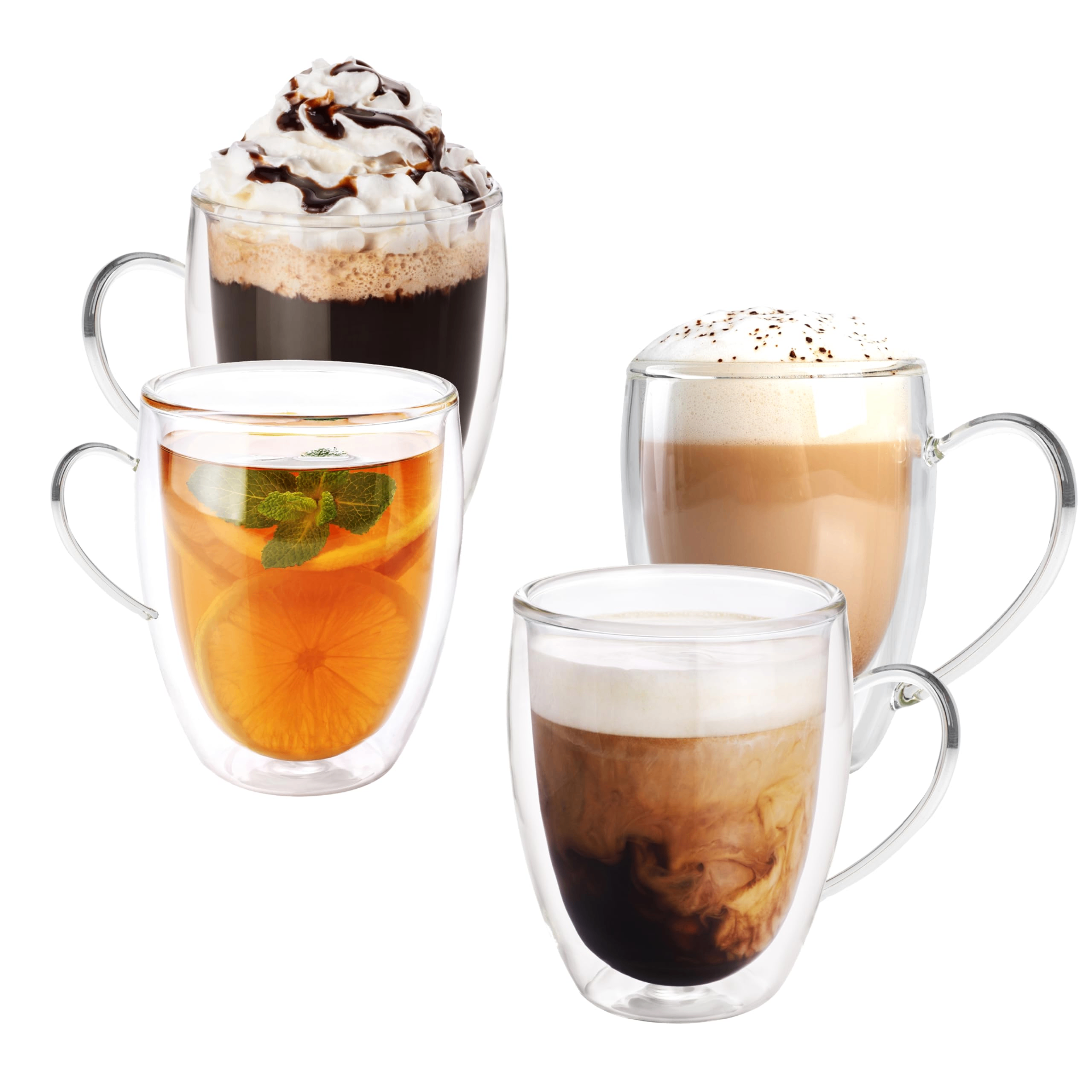
Why Double-Wall Glass Cups Keep Coffee Hotter (And Your Fingers Cooler)
Pour an espresso into a ceramic mug and the cup itself becomes the first thing your drink heats up. By the time the mug feels warm in your hand, your coffee has already given up several degrees. A double-wall borosilicate glass changes that equation completely.
The trapped air gap is the entire secret
A double-wall glass is two layers of borosilicate fused together at the rim and base, with a sealed pocket of air in between. Air is one of the worst conductors of heat we have access to in a kitchen — far worse than ceramic, far worse than steel, far worse than single-wall glass. That pocket effectively turns the cup into a tiny vacuum-flask-without-the-vacuum.
Hot stays hot, cold stays cold, hands stay comfortable
The same insulation that slows heat from leaving your drink also slows heat from reaching the outer wall. That is why you can hold a double-wall cup of espresso bare-handed — and why your iced latte does not sweat rings onto your table.
Why borosilicate, and not regular glass?
Borosilicate is the family of glass invented by Otto Schott in the 1890s, originally for laboratory glassware. It has a much lower coefficient of thermal expansion than ordinary soda-lime glass, which means it tolerates sudden temperature changes — pouring boiling water into a cold cup, rinsing a hot cup under cold water — without cracking. For a coffee or tea glass that lives between hot drinks, dishwashers and freezers, borosilicate is the only sensible choice.
How much longer does your coffee actually stay hot?
Independent home tests consistently show double-wall borosilicate cups keep an espresso-based drink within 'drinking-temperature' range (roughly 55–65°C) for 25–40 minutes — about twice as long as the same drink in a single-wall ceramic mug. Not a thermos, but a meaningful difference for the slow Saturday morning coffee.
Quick answers
Are double-wall glass cups microwave safe?+
Most borosilicate double-wall cups, including Kazomo's, are microwave-safe. Avoid extreme thermal shock — do not move them directly from freezer to microwave.
Do double-wall glasses break easily?+
Borosilicate glass is more resistant to thermal shock than regular glass but still mechanically fragile. Treat it as fine glassware.